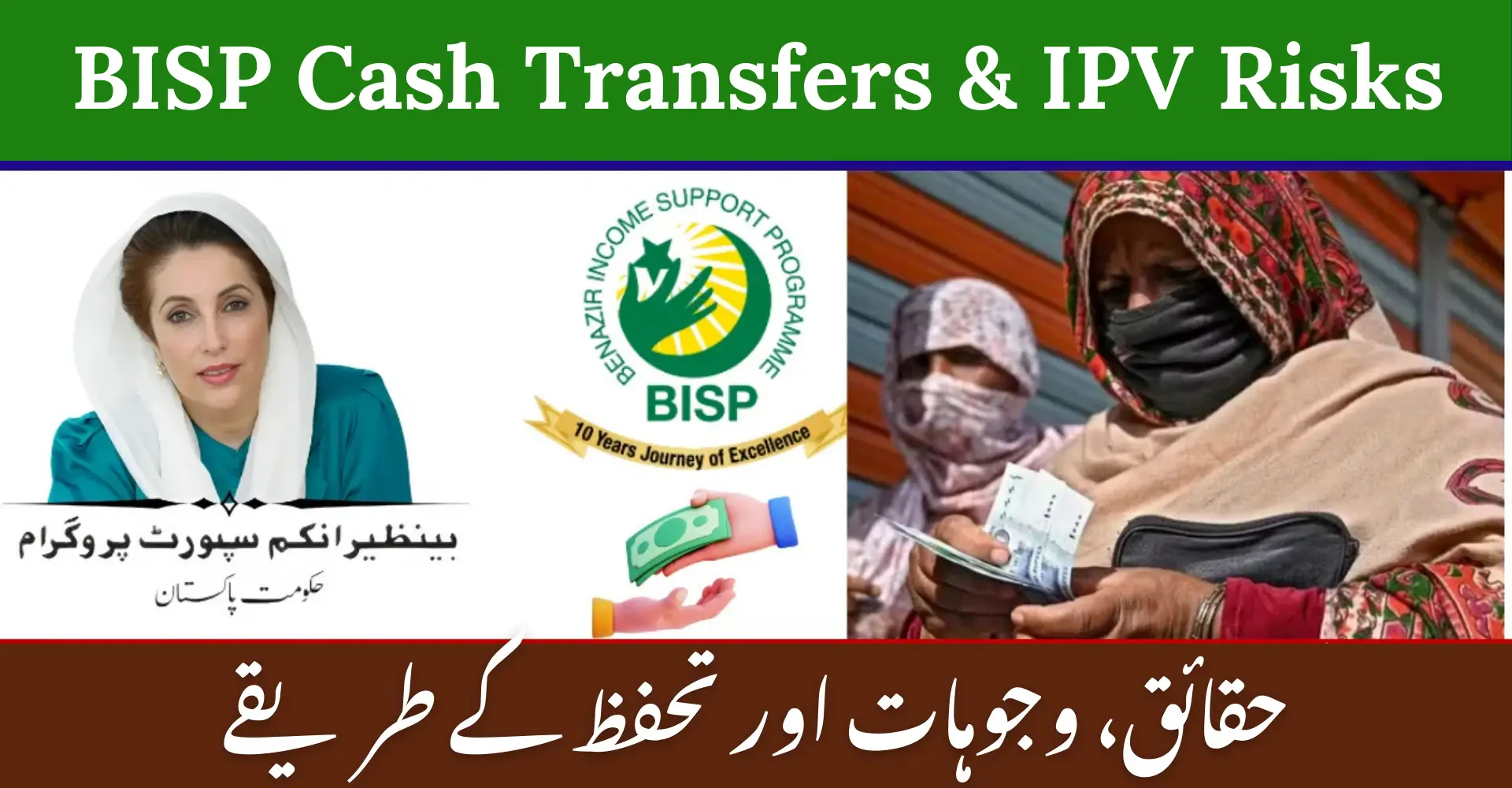
BISP Cash Transfers & IPV Risks. BISP cash transfers have long acted as a financial safety net for vulnerable women in Pakistan. But as the Benazir Income Support Programme (BISP) removes over 820,000 women from its registry in late 2025, concerns about Intimate Partner Violence (IPV) are rising sharply in 2026. This article explains what’s changing, why it matters, and how families can stay protected.

What Is BISP and Why Does It Matter in 2026?
The Benazir Income Support Programme (BISP) is Pakistan’s largest social protection initiative, designed to provide unconditional cash transfers to low-income women.
Key Objectives of BISP
- Reduce poverty and food insecurity
- Improve women’s financial autonomy
- Support children’s education through Taleemi Wazaif
- Act as a household stress buffer during economic shocks
In 2026, BISP has entered a critical transition phase due to NSER re-verification, which directly affects women’s economic security.
Understanding IPV (Intimate Partner Violence) in Economic Context
Intimate Partner Violence (IPV) refers to physical, emotional, psychological, or economic abuse by a spouse or partner.
Why Cash Transfers Affect IPV
Global research from institutions like the World Bank, IFPRI, and UN Women confirms that economic stability directly influences household power dynamics.
When women receive direct cash support:
- Household tension decreases
- Dependency reduces
- Negotiation power improves
This makes BISP more than just a welfare program—it becomes a violence prevention mechanism.
The “Safety Net” Effect of BISP Cash Transfers
Consistent BISP payments have shown a protective effect against domestic violence through three major pathways.
1. Reduced Economic Stress
Regular income lowers disputes over:
- Food expenses
- Healthcare costs
- School fees
Less financial pressure = fewer conflict triggers.
2. Increased Bargaining Power for Women
Direct transfers into women’s accounts:

- Improve decision-making authority
- Reduce complete dependence on spouses
- Strengthen their role in household planning
3. Improved Emotional Well-being
Men experience less “provider role strain”, a well-documented cause of aggression in financially stressed households.
What Happens When BISP Payments Suddenly Stop?
The December 2025 NSER update removed approximately 820,000–830,000 women due to higher PMT (Proxy Means Test) scores.
Major Risks of Sudden Discontinuation
| Risk Factor | Impact on Household |
|---|---|
| Extractive Violence | Accusations of hiding money can trigger abuse |
| Loss of Financial Autonomy | Women lose control over personal expenses |
| Income Shock | Poverty-related stress returns |
| Child Welfare Decline | Reduced spending on education and nutrition |
The “Extractive Violence” Risk Explained
One of the most dangerous outcomes is extractive violence.
How It Happens
- Husband believes payments are still coming
- Woman is blamed for “losing” household income
- Pressure escalates into emotional or physical abuse
This risk is highest when communication is unclear, which has been a major issue in recent BISP removals.
Impact on Women’s Financial Independence
Without BISP support, women often lose access to:

- Healthcare services
- Transport money
- Emergency savings
This financial dependency trap reduces their ability to:
- Negotiate household decisions
- Seek external support
- Exit abusive relationships
Ripple Effects on Children and Education
BISP discontinuation doesn’t only affect women.
Key Child-Level Impacts
- Reduced Taleemi Wazaif participation
- Lower school attendance
- Poor nutrition quality
- Increased household arguments over expenses
Children’s welfare decline often intensifies marital conflict, indirectly increasing IPV risk.
What Research Says: 2025–2026 Evidence
A 2025 working paper by Jalal studying districts like Layyah revealed mixed outcomes.
Key Findings
- Some women showed no immediate loss of empowerment
- Long-term confidence gains from BISP persisted
- Over 50% of removed beneficiaries were not informed properly
Researchers warn that lack of communication is one of the strongest predictors of male backlash.

Government Response and Protection Measures in 2026
Recognizing these risks, policymakers have introduced new safeguards.
Domestic Violence Bill 2025
Passed in November 2025, this law:
- Criminalizes economic abuse
- Introduces penalties up to 3 years imprisonment
- Strengthens protection orders for women
BISP Re-Verification & Appeals
- Removal is not punishment
- Appraisal Centers allow appeals
- Women can request PMT reassessment
These steps aim to reduce household tension caused by sudden income loss.
What Women Can Do If Removed from BISP
Practical Steps
- Visit nearest BISP Tehsil Office
- File an appeal at an Appraisal Center
- Keep CNIC and household records ready
- Seek legal aid if facing domestic abuse
FAQs
Does BISP cash transfer reduce domestic violence?
Yes, multiple studies show that consistent cash transfers reduce IPV by lowering economic stress and improving women’s bargaining power.
Why were so many women removed from BISP in 2025?
Women were removed due to updated NSER PMT scores, indicating improved household economic conditions.

Can women appeal BISP removal in 2026?
Yes, BISP allows appeals through Appraisal Centers and re-verification processes.
What is economic abuse under the Domestic Violence Bill 2025?
Economic abuse includes restricting access to money, forcing financial dependence, or punishing women for income loss.
Conclusion
BISP cash transfers are not just financial aid—they are a protective shield against IPV. As Pakistan moves through 2026 reforms, clear communication, legal protection, and accessible appeals are critical to prevent household violence.